2026 FIFA World Cup: Why Spain Team Won the Tournament
Tue, 28th Jul, 2026
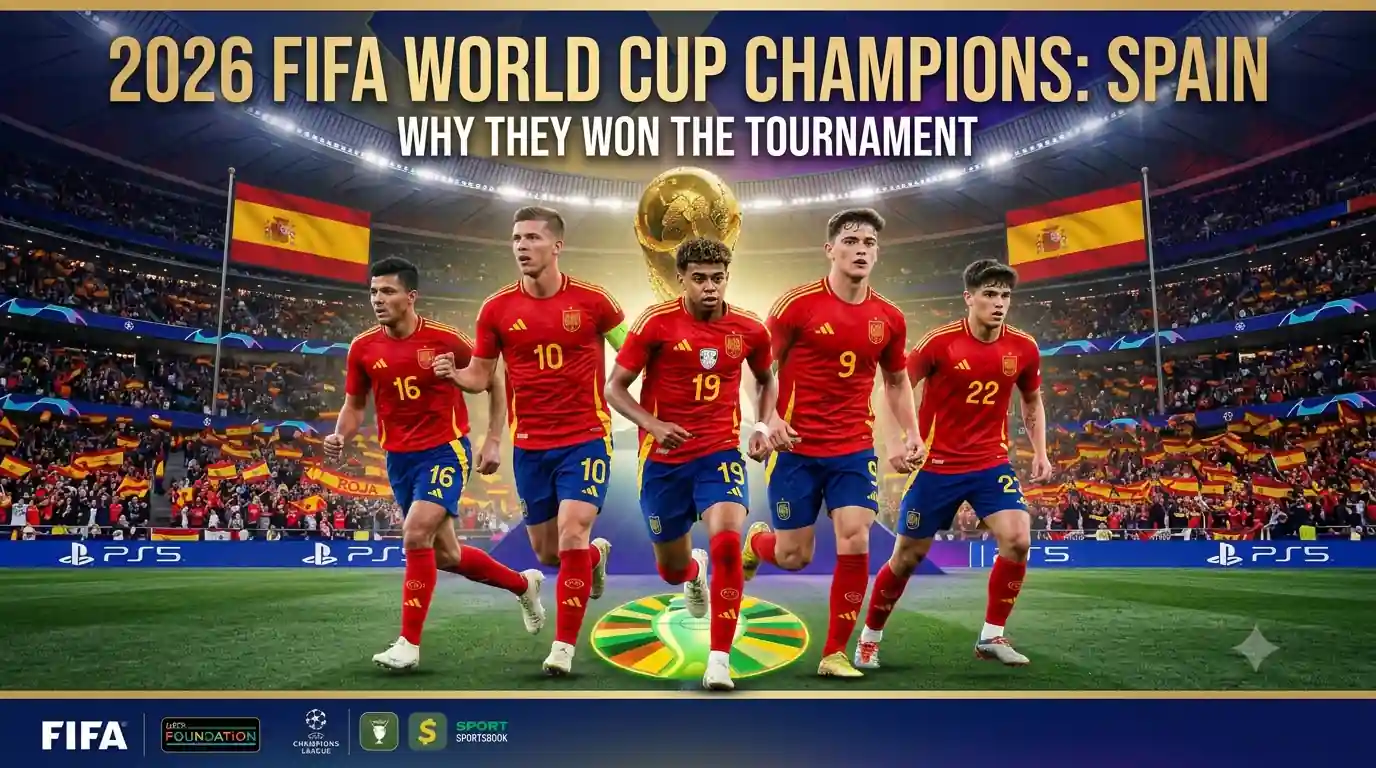
La Roja showed to the whole world that they are an international football powerhouse, defeating the Argentine team in the 2026 FIFA World Cup final. Moreover, it can be said with great confidence that Spain has managed to cement its status as an international football superpower after winning the 2026 FIFA World Cup.
Besides, Spain’s head coach Luis de la Fuente has become the first person to win two FIFA Cups in his career, having also won the UEFA Euro 2024 Cup with Spain.
Furthermore, at the 2026 FIFA World Cup, the 65-year-old became the oldest-ever manager to win the FIFA World Cup.
Below are the match highlights and tactical analysis of why Spain team won the FIFA World Cup 2026.
Spain vs. Argentina Match Highlights: Extra-Time Drama at MetLife Stadium
In the final match of the 2026 FIFA World Cup, two footballing powerhouses from across the Atlantic clashed, with Argentina going up against Spain’s tiki-taka. Right from the start, Spain took control of the match as they completely dictated its flow.
Their incredible pressuring made it impossible for Argentina to mount any significant attack. Altogether, the defending champions did not manage to register a single shot on target during the first 90 minutes.
But what stood out about Argentina’s game, and more importantly, became their salvation, was Emiliano “Dibu” Martinez’s performance. The Argentinian captain had literally saved his team from a rout as he and the rest of the defenders held firm for 90 minutes.
However, that changed when Enzo Fernández was shown a red card, which immediately shifted the momentum of the match. Subsequently, and with the numerical advantage, Spain made several changes that saw them score a controversial goal that was initially disallowed to Nico Williams due to an offside.
Then in the 106th minute, Ferran Torres scored from a corner following a great header from Williams.
In doing so, the Mestalla stadium was electrified, and La Roja’s nerves were frayed as they had to withstand a late challenge from Argentina, with Messi playing his final match in the world cup. Altogether, the Spanish team managed to do so and crowned their campaign with a 3-2 victory. More details about this memorable match can be found in the article here.
World Cup Tactical Analysis: Why Spain Winning Makes Sense
It goes without saying that Spain’s win demonstrates that Luis de la Fuente is one of the best coaches in the world. But how exactly did he steer the Spanish team to victory?
Horizontal Passing & Higher Intensity Pressing
Unlike other Spanish coaches who employed a policy of horizontal passing, De la Fuente introduced more direct pressing. Specifically, whenever they lost the ball, the Spanish team pressed their opponents in a restructured format.
De la Fuente made the trio of the midfield – Rodri, Pedri, and Ruiz – form a triangle with Rodri at the base. This tactic saw Spain record an incredible 6.4 Passes Per Defensive Action (PPDA) compared to the league’s average of 9. This way, Spain became the team with the lowest PPDA in the 2026 FIFA World Cup.
Another impressive statistic about Spain’s defense is that they registered 84 high turnovers in the opponent’s third.
Wingmen’s Explosive Attacking
It is worth noting that Luis de la Fuente also implemented explosive attacking plays from the flanks, which caused major problems for every team they faced.
Specifically, with Lamine Yamal on one wing and Nico Williams on the other, every defense had to be on high alert as these two could beat any defender one on one and drive into the penalty area.
Consequently, full-backs had to surge forward and leave massive defensive gaps in the center. These spaces were populated by Pedri and the incoming midfielders, creating numerous scoring chances.
Rodri – the Anchor Man
It was up to Rodri to advance the ball from Spain’s half, and he did so while recording a remarkable 92.4% of successful passes.
This statistic speaks volumes about De la Fuente’s mastery as a coach, which derives from the vertical use of the Spanish team. This approach to attacking is built on extremely fast passes.
Moreover, when marked by the opponent’s defenders, De la Fuente would rotate Rodri with Martin Zubimendi, confusing the mark, while also retaining control of the midfield.
Unbeaten Defense Becomes an Integral Part of Spain’s Football Philosophy
Spain’s defensive strategy deserves a special distinction as it played a critical role in helping La Roja win the 2026 FIFA World Cup.
Their defensive wall has set a new FIFA world record for the fewest goals conceded by a defending champion, with only one in eight matches. This feat is incredible considering the fact that Spain has competed in the expanded 48-nation format. Previously, the record was held by France in 1998 and Italy in 2006, with two goals in seven matches.
The defensive wall comprises Pau Cubarsí, who records an incredible 89% of tackles, Unai Simón, who has kept seven clean sheets in eight matches and won the Golden Glove award, and Marc Cucurella and Dani Carvajal, who recover the ball quickly after a failed attack.
Conclusion
A great advantage that the Spain national team had over its competitors was that De la Fuente had previously coached his players when they were teenagers. Consequently, he knew their game and could devise attacking and defensive strategies that would produce results.
This time around, he did not rely on isolated superstars but employed a football system in which his players played like one organism. learn more trending football news.
Frequently Asked Questions (FAQ)
Who won the 2026 FIFA World Cup final?
Spain won the 2026 FIFA World Cup final by defeating Argentina 1-0 after extra time at MetLife Stadium in New Jersey.
Who scored the winning goal in the Spain vs Argentina World Cup final?
Substitute Ferran Torres scored the decisive winning goal in the 106th minute following a header assist from Nico Williams.
How many goals did Spain concede during the 2026 World Cup?
Spain conceded just 1 goal across their 8 matches, setting a new FIFA World Cup record for the fewest goals conceded by a winning team in tournament history.
Who won the individual awards at the 2026 World Cup?
Golden Ball (Best Player): Rodri (Spain)
Golden Glove (Best Goalkeeper): Unai Simón (Spain)
Young Player of the Tournament: Pau Cubarsí (Spain)
Golden Boot (Top Scorer): Kylian Mbappé (France – 10 goals)
What tactical system did Luis de la Fuente use for Spain?
Luis de la Fuente utilized a flexible 4-3-3 / 4-2-3-1 formation focused on high-intensity counter-pressing, rapid vertical transitions through wingers Lamine Yamal and Nico Williams, and high midfield control led by Rodri