2026 World Cup Group Stage Forecast: Which Heavyweights Face the Highest Risk of an Early Exit?
Sun, 21st Jun, 2026
Introduction
The 2026 FIFA World Cup is truly an intense competition and it is widely believed that the best teams actually succeed and win the tournament.
However, history tells us a different story. Statistically, pre-tournament betting favorites go on to lift the FIFA World Cup trophy only about 23% of the time. This simply means that the heavyweights are mostly humbled by underestimated teams.
These underestimated teams are usually very disciplined. The heavyweights also fail because they pay less attention to the effects of cross-continent travel and tight tactical matchups. You can check out our article on underdogs who have a high chance of winning the World Cup here.
The 2026 FIFA World Cup adds a whole new challenge to the mix. This year's World Cup has expanded to a 48-team format across three nations – the United States, Canada, and Mexico. This means that there is little gap for error.
32 teams will progress to the new round of 32. This includes the top 2 from all 12 groups in addition to the eight best third-place position holders. Due to this novel format, several world-class squads have to be really cautious, because one tiny mistake might cost them their World Cup spot.
So, sports bettors looking at the “To Not Qualify" market should also consider backing a heavyweight team to crash out of the tournament. Let's dive deep into our forecast for the 2026 World Cup group stage. We will analyse three elite teams that stand the risk of a shocking exit.
Five Elite Teams that Face the Risk of Elimination
Due to the tactical versatility of underdog nations and them being underestimated, these are the list of world-class teams that face the risks of elimination:
1. Belgium (Group G)
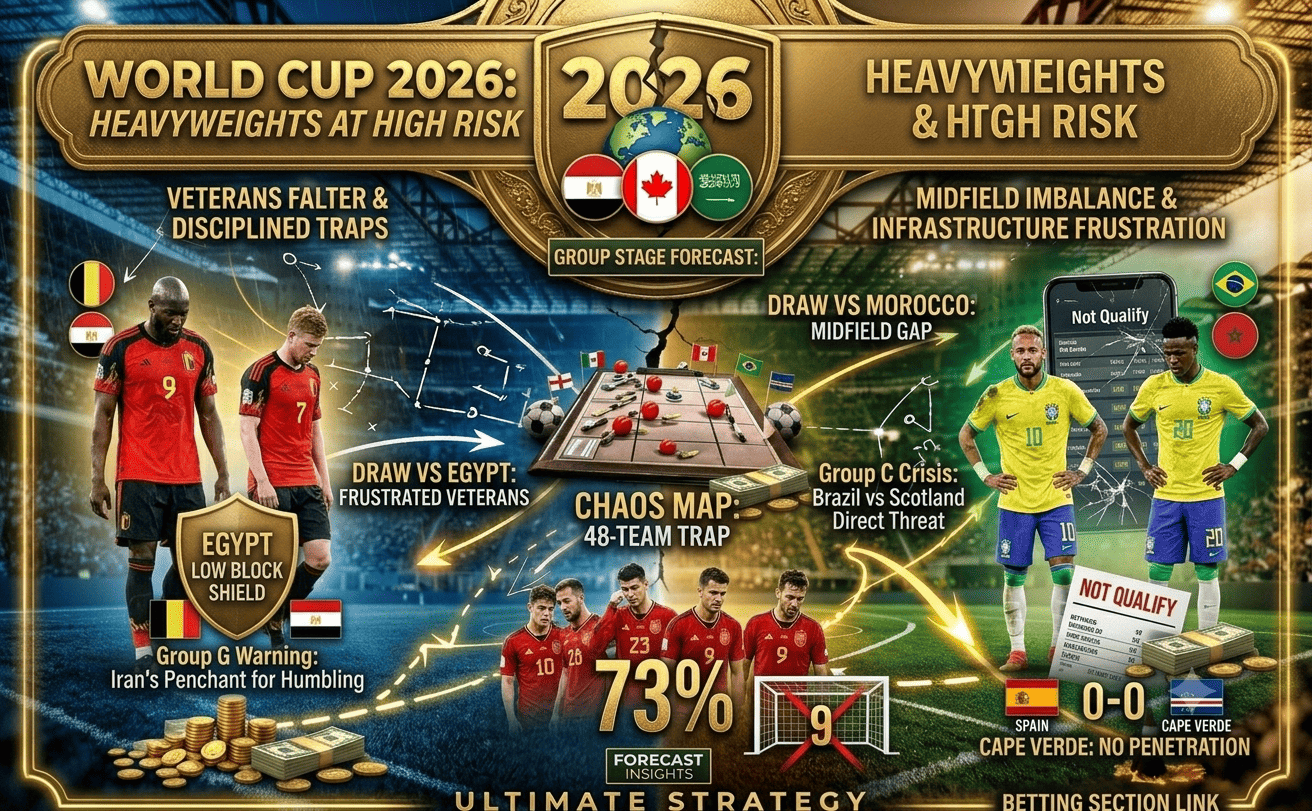
Belgium’s opening match in Seattle exposed its weaknesses. After a frustrating and shocking draw against Egypt, it sent a signal to the football world.
Under Domenico Tedesco, Belgium has experienced a new wave of youngsters. However, they remain reliant on veteran playmakers. The downside is that these veterans lack the speed to match the pace of the World Cup tournament.
Their bout with Egypt showcased exactly how to neutralize them. By sitting deep in a low block, cutting off central passing lanes to Romelu Lukaku, and unleashing direct counter-attacks behind their advanced fullbacks, Egypt were able to thwart Belgium.
Their next match is against an extremely disciplined Iran squad. The Iranian squad has a penchant for humbling elite teams. If the Belgium team is not successful, they will find themselves out of the tournament.
2. Brazil (Group C)
Group C started with an absolute shock. Currently, Scotland sits at the top of the table after a comfortable victory over Haiti. Then Brazil drew their match with Morocco. It ended 1-1.
This was so shocking because Brazil currently possesses some of the most expensive attackers. However, tournament football is usually won by the defense and midfield.
Brazil currently has a midfield imbalance and is suffering from navigation or massive distances.
They will face Scotland soon and it is a scary sight. This is because the Scottish side plays a more direct and physical style of play. This could pose a lot of problems for Brazil.
3. Spain (Group H).
Spain found themselves in a goalless draw against Cape Verde. This was extremely upsetting because Spain controlled over 73 percent of total possession. Even after completing over 700 passes, it was clear that La Roja suffered from a historical problem.
This refers to an absolute lack of vertical penetration and a clinical number nine. Also, Cape Verde employed a strong defensive formation that limited Spain's plans.
If Spain cannot find a way to convert possession into goals against Saudi Arabia in their next fixture, they will face a high-stakes match with Uruguay. This would be highly risky because Uruguay’s playing style will pose huge problems for them and they might actually be eliminated.
Conclusion: Why you should look into the “Not Qualify” Market
There are many markets and avenues to make money as a bettor. However, there are certain hidden gems in the market and the “Not Qualify" category is one of them.
It is one of those categories that is often overlooked because of other popular options.
However, when you explore the "Not Qualify” market, do so with an analytic mind and proven strategies. One of such strategies is betting on heavyweights. This will greatly increase your odds.
If you want more personalised bet tips, you can get our premium membership here or visit our betting section here.
Frequently Asked Questions (FAQ)
Why do pre-tournament favorites often fail at the FIFA World Cup?
Statistically, pre-tournament betting favorites only win the FIFA World Cup around 23% of the time. Elite heavyweights frequently struggle because they underestimate disciplined underdogs and fail to manage the tactical demands of cross-continental travel and rapid turnaround match schedules.
How does the new 48-team format impact group stage qualification?
The expanded format features 12 groups of 4 teams. While the top two from each group and the eight best third-place teams advance to the new Round of 32, the expanded bracket drastically thins the margin for error. A single tactical misstep or draw against a lower-seeded team can put an elite squad’s progression in jeopardy.
Why is Brazil at risk of elimination in Group C?
Despite possessing world-class, expensive attacking talent, Brazil suffers from a noticeable midfield imbalance. Following their opening 1-1 draw with Morocco and Scotland's early momentum at the top of the group, Brazil’s upcoming match against a direct, physical Scottish side presents a high-risk scenario.
What is the "To Not Qualify" betting market?
The "To Not Qualify" market is a highly valuable, often overlooked sports betting category. Instead of backing heavyweights to win at low odds, smart bettors use an analytical approach to back elite teams with clear tactical flaws to crash out early, drastically maximizing their potential returns.